
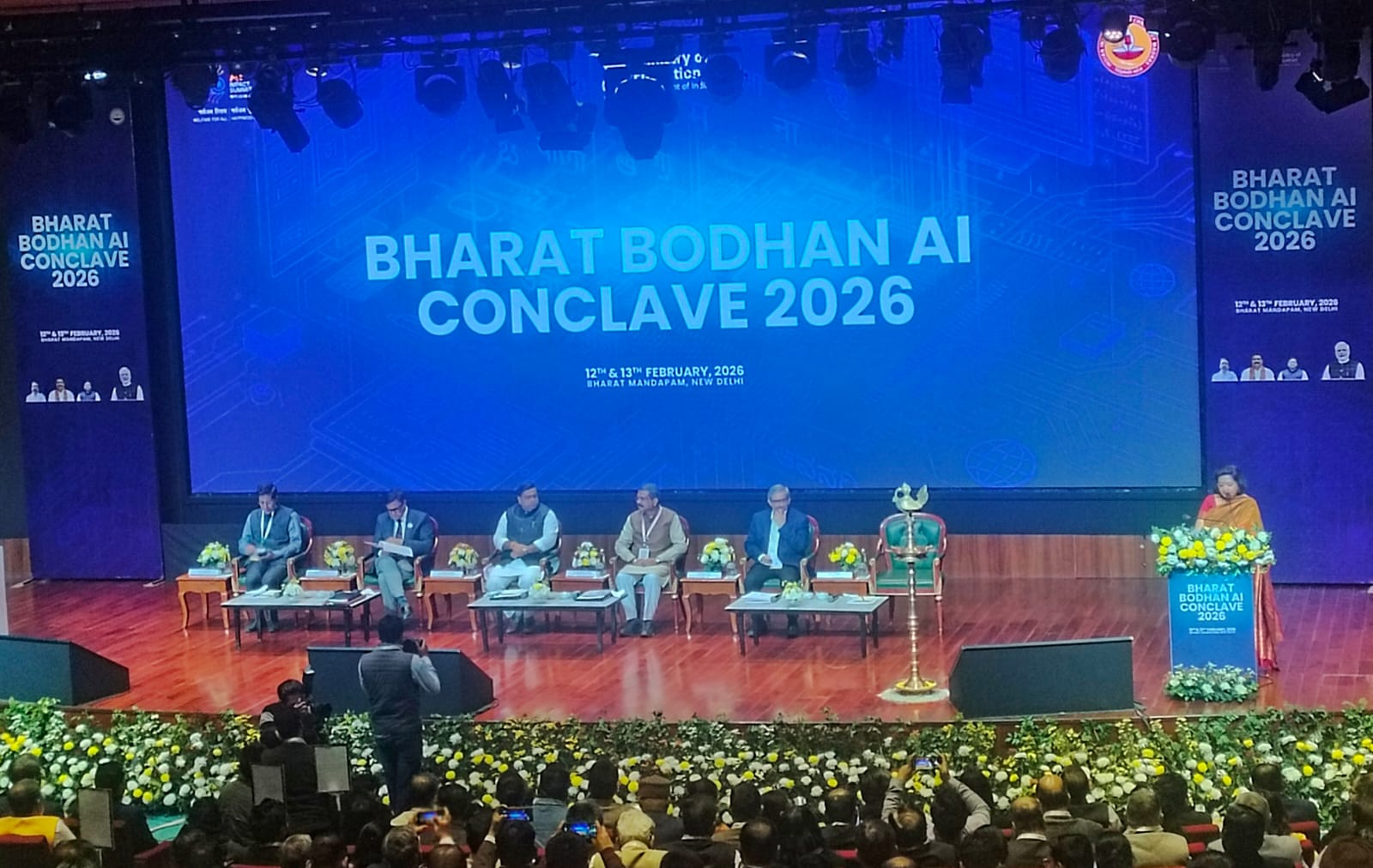
As a powerful prelude to the AI Impact Summit, the Bharat Bodhan AI Conclave 2026, held at Bharat Mandapam, set the stage for a national conversation on whether India’s school education ecosystem is ready to embrace Artificial Intelligence. The Voices student reporter brings this report from the Bharat Bodhan AI Conclave.
The Union Minister for Education, Dharmendra Pradhan, inaugurated this two-day conclave held by the Ministry of Education, Government of India, at Bharat Mandapam, New Delhi on 12-13 February 2026 that brought together over 3100 people — including more than 600 delegates, 2000 students, 117 exhibitors, policymakers, state officials, academicians, philanthropic institutions and edtech innovators.
Conclave explored ways the artificial intelligence can transform Foundational Literacy and Numeracy (FLN), strengthen teacher effectiveness, improve governance and enable multilingual inclusion across India’s vast school ecosystem.
Sanjay Kumar, Secretary, Department of School Education & Literacy, Government of India, called upon for the responsible use of AI. He added that AI usage will lead to better learning outcomes in the classroom, make learning more enjoyable and improve the classroom transaction for better pedagogy. AI is giving us an opportunity to reach out to every student and adapt to the understanding of that student, he reasoned.
Platform for Decisive AI:
The conclave provided a vibrant platform for dialogue, discovery, and deployment, where stakeholders not only discussed AI but also examined its responsible use to bridge the digital divide and modernise governance. It focuses on developing strategies for India’s AI-driven educational future, ensuring innovation remains scalable, inclusive, and teacher-led.
A breakthrough moment was the launch of the Bodhan AI Centre of Excellence, a national platform for landscape discovery, strategic alignment and partnership building in AI-enabled education. The centre has been opened at IIT Madras. Speaking at the event, Prof. V. Kamakoti, Director, IIT Madras, said that the real challenge lies in preparing teachers and parents and strengthening school infrastructure to effectively adopt AI tools.
From Vision to Implementation:
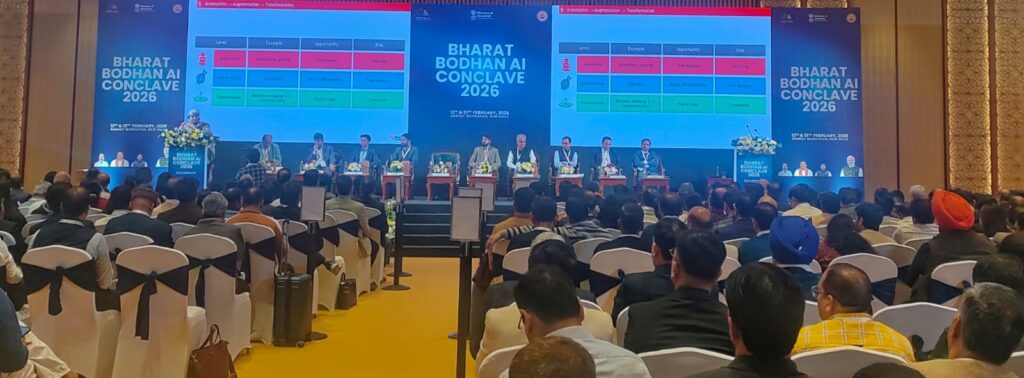
Four technical sessions showcased the way AI is already reshaping classrooms, institutions and governance across different states through varied stakeholders.
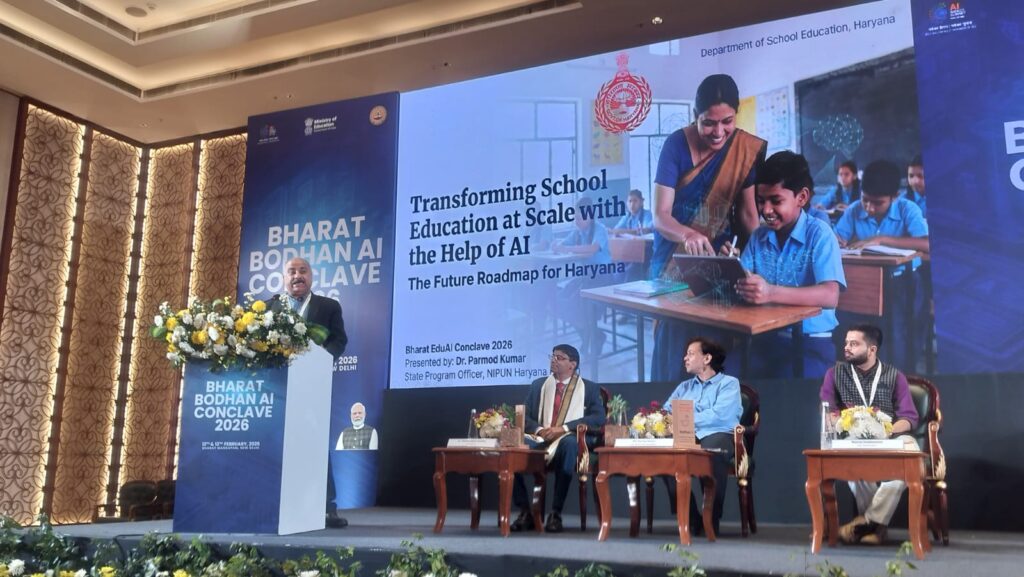
Dr. Parmod Kumar, State Project Officer from Haryana, highlighted the transformative impact of the AI-integrated NIPUN (National Initiative for Proficiency in Reading with Understanding and Numeracy) Haryana app. He claimed that the initiative has conducted over 12 lakh assessments, trained more than 31,000 teachers and evaluated more than 8000 schools. By replacing the traditional “one-size-fits-all” model with AI-driven professional development ecosystems, Haryana is personalising teacher training while significantly reducing manual workload.
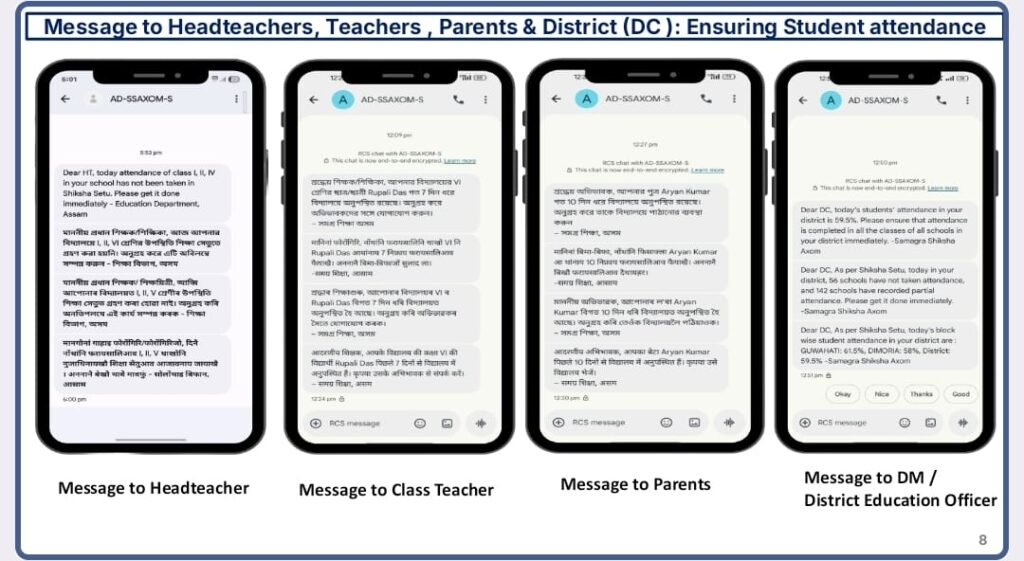
From Assam, Dr. Om Prakash, IAS, State Mission Director, Assam, presented the AI-powered Shiksha Setu, Axom portal and application. To address student attendance challenges, the system analyses real-time data and sends alerts via Vidya Samiksha Kendra (VSK) to teachers, principals, parents, and district education authorities or the district magistrate when a student is absent for extended periods. He added that the impact of this initiative has been remarkable. The system has identified over 3 lakh “ghost students”, improved attendance, restored broken linkages, and flagged early dropouts before it was too late. The Shiksha Setu, Axom portal, and application were launched in 2023, and to date, the application has garnered prominent awards for Assam, including the National Award for e-Governance, 2024, and the Prime Minister’s Award for Excellence in Public Administration, 2024.
Classroom Revolution With Personalised Learning:
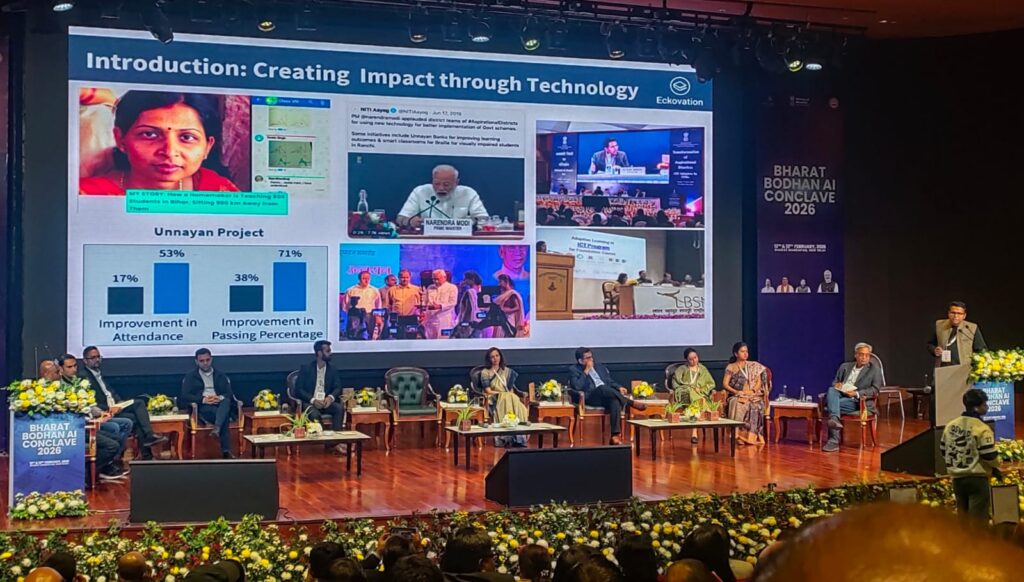
AI’s promise in the classroom was further amplified by edtech leaders. Ritesh, CEO and co-founder of Ecovation, is the CEO and co-founder of Ecovation, a social learning platform and mobile application that improves educational outcomes. He shared insights from his work in Bihar, where he observed a fundamental challenge: no two children learn at the same pace. Bihar Education launched a pilot project, The Unnayan Banka, in 2017 with Ecovation, covering five government schools. the success of the project was further replicated in thousands of schools in Bihar under the project named “Unnayan Bihar”. The school infrastructure was leveraged to its fullest potential through AI-enabled applications, high-quality audiovisual content, peer learning, and other initiatives, leading to improved learning outcomes. The project was subsequently adopted in states such as Uttar Pradesh and Jharkhand. He said that the AI-enabled adaptive learning, he explained, can generate personalised lesson plans and assessments tailored to each student’s level, empowering teachers to bridge learning gaps within a single classroom.
Innovation Beyond The Classroom:
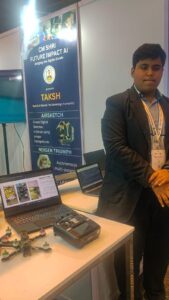
The exhibition floor was equally inspiring. Among the standout innovators was Dev Priya, a Class XI student from CM SHRI School, Dwarka, New Delhi, who is running an aerospace-focused, defence venture named Vector Aerotech. Talking to The Voices, Dev Priya said that he has been working for the past 9 years, has an annual turnover of around Rs 2 crores and desires to retire by the age of 26. AI-enabled devices drew considerable attention, symbolising the spirit of innovation that the conclave sought to nurture, where students are not just learners, but creators.
The Road Ahead:
The Bharat Bodhan AI Conclave 2026 was more than a conference; it was a collective signal that India’s school education ecosystem is moving from experimentation to execution. The two-day conclave focused on building a nationwide education AI ecosystem through the proposed Bharat Education AI Stack—an open, interoperable digital framework designed to support schools, universities, skilling and research.
As India approaches the AI Impact Summit, the conclave offered a powerful insight: the future of school education will not be defined by technology alone, but by how responsibly and collaboratively it is woven into classrooms, governance systems, and communities. The Bharat Bodhan AI Conclave 2026 provided a collaborative platform that brought together policymakers, educators, technology leaders, and academic experts to deliberate on AI-driven transformation in education.
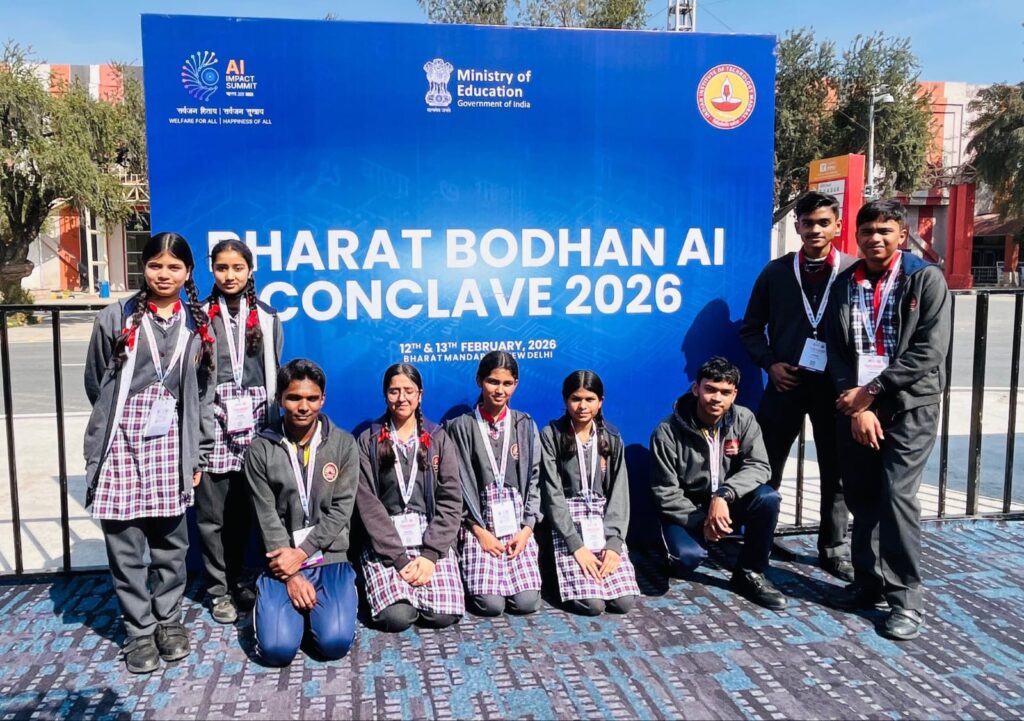
Schools are ready to use AI, provided they have adequate infrastructure and full government support. This conclave served as a pre-discussion for the AI Impact summit, taking place February 16-20, 2026, with a focus on People, Planet, and Progress, and promoting AI innovation and governance across the sector.
Copy Editor: Megha Mann